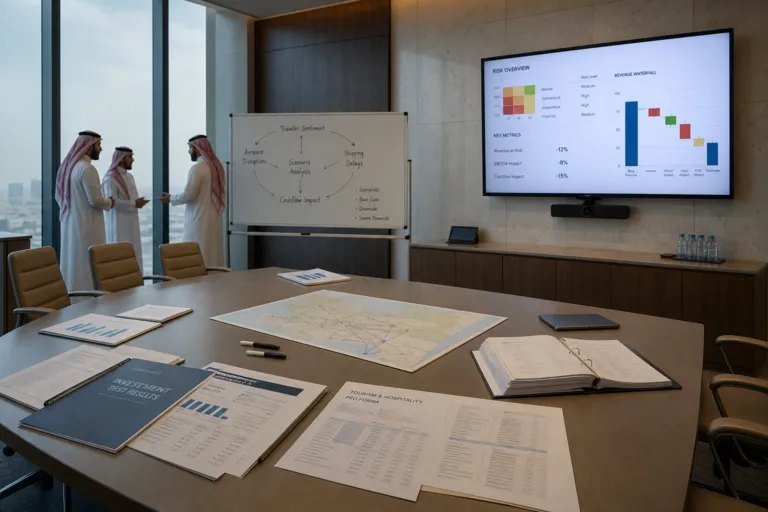
The 2026 conflict in the Gulf forced investors to re-price risk across the region’s travel economy, including Saudi Arabia’s tourism and hospitality pipeline. CES Intelligence describes a battlefield environment in which all six GCC states have been struck by Iranian missiles and drones since the war began on 28 February 2026, underscoring that risk is not confined to one border. In this setting, tourism exposure is not only about demand. It is also about operational continuity, insurance costs, and whether aviation and shipping corridors stay usable long enough for hotels, attractions, and retail to keep converting bookings into cash.
Tourism demand shocks were visible through disrupted connectivity and heightened traveler risk aversion. Deloitte notes that flight disruptions curtailed inbound bookings, especially premium and transit segments that rely on international connectivity, and that historical conflict episodes have produced declines in occupancy, ADR, and RevPAR across affected and neighboring markets. Hospitality Net frames the episode as a systemic test, citing WTTC calculations of USD600M in daily losses in visitor spending during the active conflict period across the Middle East. That same source argues the shock implied a 2–4 year setback to Saudi Vision 2030, illustrating why underwriting based on smooth trend growth can fail under conflict-driven volatility.
What Investors Should Stress-Test in Saudi Tourism Deals
First, stress-test corridor risk as a revenue driver, not a macro headline. CES Intelligence reports Hormuz throughput collapsing from 19–20 million bpd to a fraction of pre-war levels, with six recorded transits on 30 August versus a baseline of roughly 85 per day. It also notes that Yanbu and Fujairah reroute barely a quarter of pre-war volumes, while attacks on Jazan and Red Sea shipping target the bypass system itself. Fitch Solutions adds that prolonged disruption to shipping through the Strait of Hormuz reinforces the strategic importance of inventory resilience. Even if a tourism asset is far from the waterway, these constraints can tighten financial conditions and complicate supply chains that keep properties operating.
Second, investors should stress-test confidence and capital timing, because uncertainty can change investment appetite quickly. A Saudi market analysis cites UNCTAD figures showing Saudi Arabia attracting USD1.6B in FDI in 2021 versus USD5.6B in 2020, and it cites a PwC finding that 79% of international investors view geopolitical instability as a major risk when considering investment in Saudi Arabia. The same analysis references an Arab News-reported 2022 survey in which 62% of businesses in Saudi Arabia experienced declining confidence due to regional conflicts and geopolitical uncertainty. For tourism underwriting, that mix can translate into delays, refinancing risk, or slower ramp-ups even when projects remain strategically important.
Third, stress-test the demand mix and recovery path. Hospitality Net argues recovery will be uneven and points to non-discretionary religious tourism as more resilient, citing Hajj participation of 2–3 million annually and Umrah drawing 8–10 million visitors. That contrasts with segments Deloitte flags as most exposed to connectivity shocks, like premium and transit demand. Finally, portfolio pricing should reflect that the GCC’s transformation efforts coexist with live security exposure. The Global Atlas of Risk and Readiness Report 2026 states the six Gulf markets average 84.87 overall, with an average risk score of 65.60 and an average readiness score of 75.34, suggesting improving readiness while risk remains material. For geopolitical risk in Saudi tourism investment, the practical takeaway is to model both resilience levers and sudden interruption scenarios.
What did the 2026 conflict change for Saudi tourism and hospitality investors?
Which operational chokepoint risks should be included in stress-tests?
How did investor sentiment and capital flows show sensitivity to geopolitical instability?
What demand segments may be more resilient in a regional shock?
How should geopolitical risk in Saudi tourism investment be priced at the portfolio level?
Talk to us for your needs in:
-
Tourism Infrastructure Planning and Optimization
-
Destination Marketing and Brand Strategy
-
Tourism Workforce Development and Training
-
Sustainable Tourism Solutions
-
Visitor Experience Enhancement and Engagement
-
Tourism Project Feasibility and Strategic Planning
-
Saudi Tourism Benchmarking