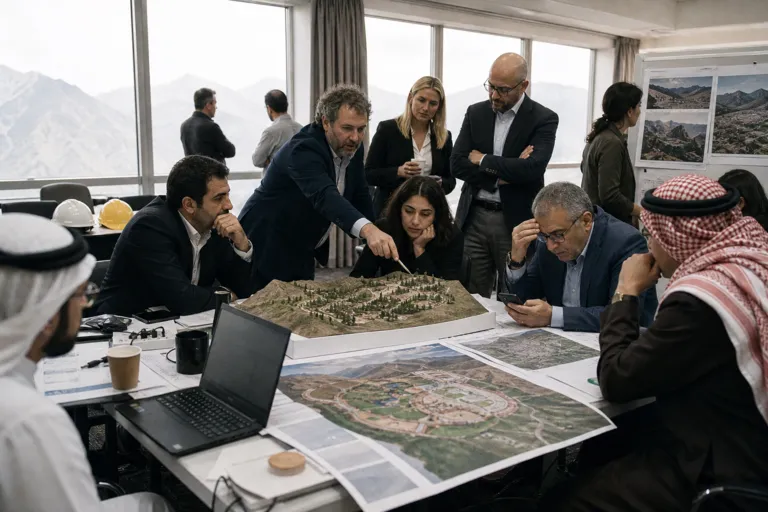
Trojena was positioned as a mountain tourism destination under construction in NEOM, in Tabuk Province, Saudi Arabia. Saudi Arabia’s planned city of NEOM was elected as the host city for the 2029 Asian Winter Games at the 41st OCA General Assembly on 4 October 2022 in Phnom Penh, Cambodia, with events planned for Trojena. That made the bid a major signal of intent, because it would have been the first Asian Winter Games held in Saudi Arabia, the Arabian Peninsula, and an Arabic-speaking country. The reversal matters because it is not just a sports headline. It changes the narrative anchor for Trojena’s build sequence and the marketing flywheel that large events can create for early-stage destinations.
The relocation itself was framed as a deadline-and-delivery issue. Reporting said the decision to move the 2029 Games was driven by the realization that Trojena would not meet strict operational thresholds by the 2029 deadline, given the scale of planned works like a vertical ski village and a massive man-made lake carved into the Sarawat Mountains. In February 2026, Trojena lost its 2029 Asian Winter Games hosting bid, with the event reassigned to Almaty, Kazakhstan. Another NEOM update also stated the Asian Winter Games at Trojena were postponed indefinitely in January 2026. However phrased, the message to markets is similar: the event-linked schedule that once shaped Trojena’s investment case weakened.
What the Shift Signals About NEOM’s Tourism Sequencing
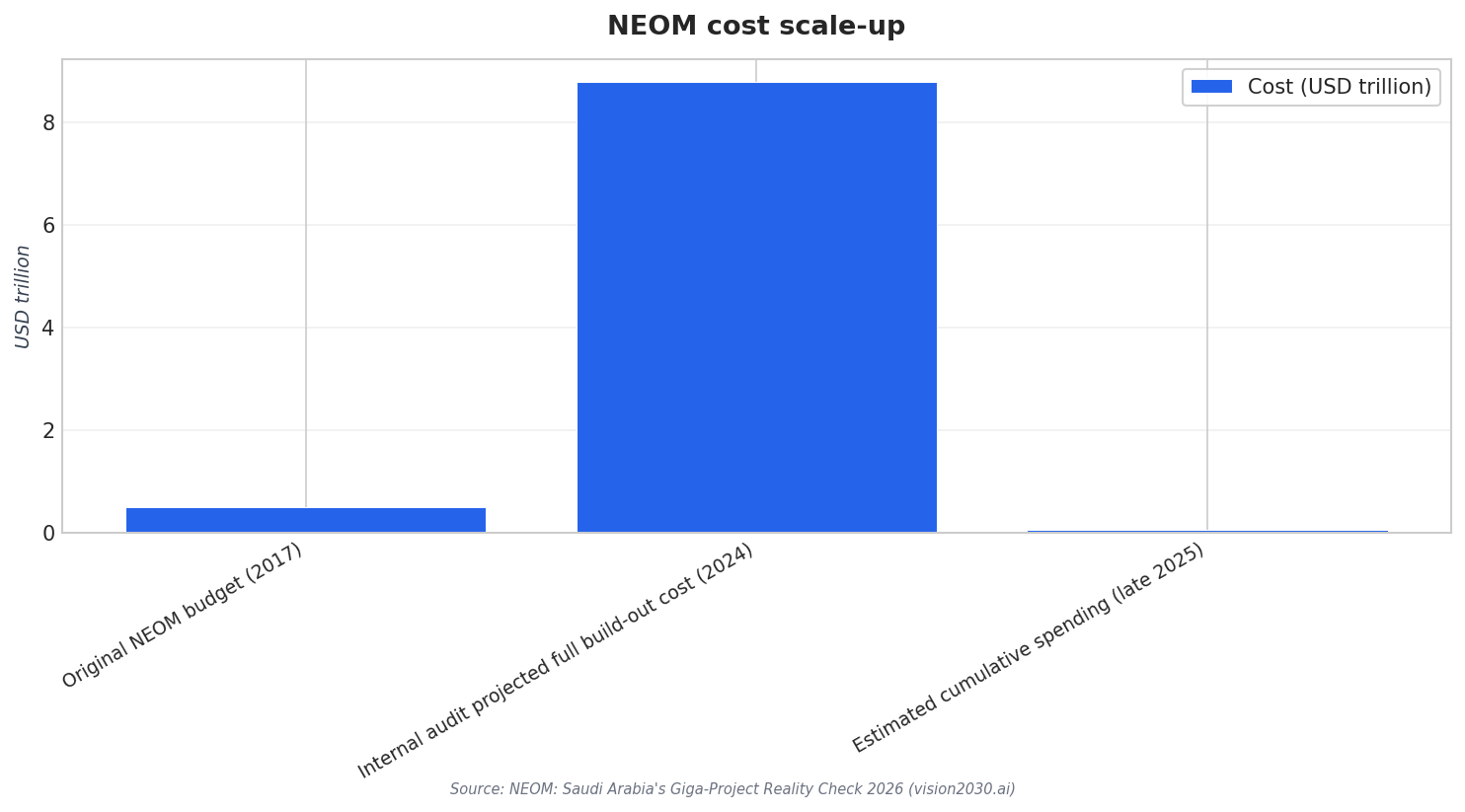
NEOM in 2026 is described as more sober than the 2017 launch vision, which bundled a 170-kilometre linear city, a floating industrial port, a desert ski resort, luxury islands, and a coastal lifestyle corridor under one PIF-owned umbrella. An internal audit reported by The Wall Street Journal projected a full build-out cost of approximately USD 8.8 trillion across a roughly 55-year timeline, while cumulative spending through late 2025 is estimated at USD 50 billion, and The Line was effectively suspended in September 2025. For tourism investors, this backdrop shifts the question from “Is Trojena a flagship that must be ready for 2029?” to “How does Trojena compete for capital and execution focus inside a portfolio where some assets are already operating and generating proof points?”
Those proof points exist, and they shape the comparison set for Trojena. Sindalah opened to invited guests in October 2024, and it is also described as the first region to open for tourism. Oxagon’s port is operational and handling cargo, and the NEOM Green Hydrogen complex is described as roughly 90% complete with first export shipments targeted for late 2026, while another update describes an $8.4 billion NGHC facility with green ammonia exports expected to begin early-to-mid 2027. A separate $5 billion DataVolt hyperscale data center campus was announced in February 2025 with first-phase operations targeted for 2028. Against that, Trojena’s investment case looks less like an event-timed sprint and more like a longer-cycle destination build that needs to prove feasibility and demand without the Games deadline.
It is also important to separate “lost event” from “stopped project.” One update says Trojena’s tunnels and base infrastructure continue even without the Olympics deadline. At the same time, Trojena reporting notes that in 2026 the Games were moved to Almaty, Kazakhstan, and that several key contracts for Trojena construction, including the dam and the supply of structural steel, were cancelled, alongside claims of cost pressure and internal review concerns. In that context, the NEOM Asian Winter Games relocation becomes a stress test of mountain tourism credibility: investors will likely scrutinize delivery sequencing, which components are still advancing, and whether tourism milestones like Sindalah’s October 2024 opening become the primary brand proof while Trojena resets its timeline logic.
What happened to the Asian Winter Games planned for Trojena?
How does the NEOM Asian Winter Games relocation affect Trojena’s tourism investment case?
Is Trojena still being built after losing the Games?
Which NEOM tourism asset is already open?
Talk to us for your needs in:
-
Tourism Infrastructure Planning and Optimization
-
Destination Marketing and Brand Strategy
-
Tourism Workforce Development and Training
-
Sustainable Tourism Solutions
-
Visitor Experience Enhancement and Engagement
-
Tourism Project Feasibility and Strategic Planning
-
Saudi Tourism Benchmarking