Saudi Arabia’s hotel story is still growth, but 2026 has made the reset visible in the capital. JLL’s KSA Hotels Market Dynamics Q2 2026 update shows Riyadh RevPAR fell 23.2% year on year, alongside an occupancy drop to 47.6%. That divergence matters because other demand bases are behaving differently. In the same JLL update, Makkah posted an 8.7% RevPAR increase in the year to June 2026, while Madinah delivered the Kingdom’s highest occupancy at 75.1%. For Riyadh owners and operators, the message is clear: the market is re-pricing risk as supply expands and corporate demand turns more competitive.
National indicators show why pricing power is harder to defend in commercial hubs. GASTAT first-quarter 2026 figures reported average hotel ADR down 11.4% year on year to SAR423, with hotel occupancy slipping 2.2 percentage points to 60.8%. The same dataset ties the softness to supply growth: licensed tourism hospitality facilities rose 22.7% year on year to 6,122, up from 4,988. Hotels represented 2,963 facilities, while serviced apartments and other hospitality facilities totalled 3,159, or 51.6% of the total. Even as guests stayed slightly longer, average hotel stays only edged up to 4.2 nights from 4.1, underlining that volume alone may not absorb incoming inventory quickly.
Supply Wave vs. Demand: What Changes for 2026-27 Underwriting
Pipeline math is now part of every investment conversation. MMCG’s 2025 analysis pointed to about 45,000 rooms under construction in Saudi Arabia, equal to about 26% of existing stock, and more than 92,000 rooms in the total pipeline. Travel Daily Media added that more than 105,000 rooms were already under construction or in advanced planning, while warning that much of that capacity will arrive regardless of short-term demand swings. In that context, MMCG argued occupancy could sit near the 60% mark through the decade, which implies longer ramp-up periods and more disciplined expectations around rate growth—especially in markets like Riyadh and Jeddah where competition is concentrating.
Even within the reset, the forward view is not uniformly negative. CoStar’s February 2026 forecast assumptions note that RevPAR in Abu Dhabi, Dubai, Jeddah, and Riyadh is expected to rise an average of 4.2% in 2026, despite a challenging development pipeline. At the same time, JLL flagged overall tourism down around 5–7% during the first five months of 2026, reinforcing that near-term volatility can sit alongside longer-term growth narratives. Separately, Knight Frank reported average hotel occupancy of 63.4% between January and April 2026, with ADR of SAR754 and RevPAR of SAR478, highlighting that performance snapshots can differ by dataset and segment mix.
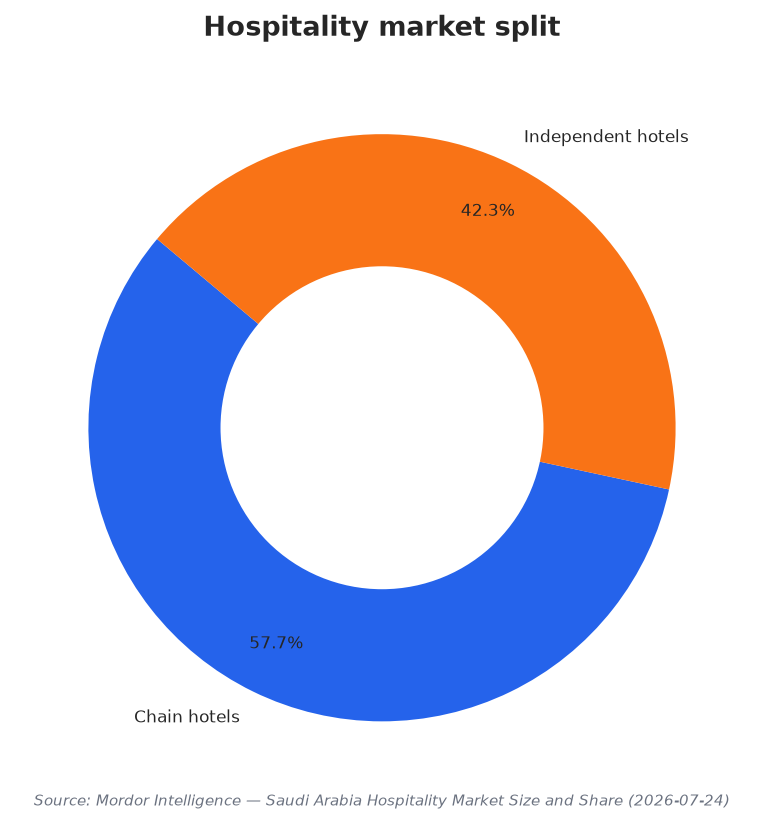
So where can value lie as the Riyadh hotel market recalibrates into 2026-27? First, track category shifts: GASTAT data shows serviced apartments holding up better, with occupancy rising to 51.6% from 50.7% and rates dipping only 1.2% to SAR206. Second, assume the consumer is real, but supply is realer. Saudi Arabia recorded 37.2 million domestic and international visitors in Q1 2026, generating SAR82.7 billion in spending, and total tourist trips hit 115.9 million in 2024. Mordor Intelligence also estimates the Saudi hospitality market at USD 29.02 billion in 2026, up from USD 27.14 billion in 2025, with projections reaching USD 40.58 billion by 2031. In a reset, value often comes from assets that can win share without relying on peak-rate assumptions, and from segments that match how travellers are actually booking and staying.
What is happening in Riyadh’s hotel market in 2026?
How fast is hotel supply growing across Saudi Arabia?
Are hotel rates falling nationally?
Which segments look more resilient during the reset?
What demand indicators still support a longer-term positive outlook?
Talk to us for your needs in:
-
Tourism Infrastructure Planning and Optimization
-
Destination Marketing and Brand Strategy
-
Tourism Workforce Development and Training
-
Sustainable Tourism Solutions
-
Visitor Experience Enhancement and Engagement
-
Tourism Project Feasibility and Strategic Planning
-
Saudi Tourism Benchmarking