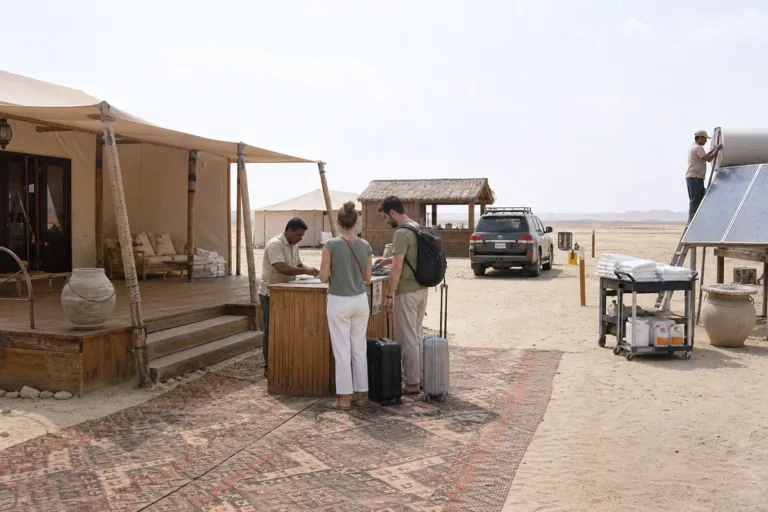
Saudi Arabia is explicitly leaning into luxury tourism as a strategic segment. A recent Vision 2030-focused study notes that prioritizing high-spending visitors can increase economic yield while mitigating congestion pressures associated with mass tourism, and it lists premium desert camps alongside exclusive resorts and high-end hospitality partnerships. That framing matters for developers looking beyond the most visible destinations. It suggests a playbook built on yield, scarcity, and experience design, not just room count. It also raises the bar on legitimacy: the same study highlights that locally inflected luxury experiences and cultural tourism can help legitimize tourism growth domestically by tying it to national identity and continuity.
For unit economics, broader national hotel performance provides a reality check on pricing power and demand depth. One 2025 market analysis reports national occupancy hovering around 60–62% over the past 12 months, versus below 40% at the height of 2020. It also describes ADR currently around $185–$190 (about SAR 700) and RevPAR roughly $115–$120, and adds that in the first half of 2025 nationwide ADR reached SAR 822 (~$219) with occupancy averaging 62.3%, while RevPAR is roughly 20% higher than the 2019 pre-pandemic average. Luxury camps do not price identically to city hotels, but these benchmarks help investors test whether a remote camp’s rate strategy is anchored in a market that is already sustaining higher nominal revenues.
Investment Models Beyond Signature Destinations
When structuring a luxury desert camp investment in Saudi Arabia, developers can borrow from how the Kingdom is positioning mega-projects while still staying flexible on site selection. Mordor Intelligence estimates the Saudi Arabia hospitality market at USD 29.02 billion in 2026 (up from USD 27.14 billion in 2025) and projects USD 40.58 billion by 2031 at a 6.93% CAGR. It also reports that the luxury segment led with 36.92% of market size in 2025, suggesting that premium formats are already a large slice of the addressable hospitality economy. On the capital-allocation side, the same source cites PIF commitments totaling USD 500 billion to NEOM alone, and notes Sindalah Island’s 2024 debut delivered an initial 440 keys as a proof-of-concept for sustainability-driven resort clusters that cap visitor numbers to protect fragile ecosystems. Camps outside NEOM can still replicate the logic: limited inventory, controlled access, and a sustainability narrative that supports higher yields.
Desert camps also sit close to the “glamping” value proposition that has scaled internationally, even if Saudi demand will have its own drivers. Grand View Research values the global glamping market at $3.8 billion in 2025 and projects growth from $4.2 billion in 2026 to $7.9 billion by 2033 at a 9.5% CAGR. It also forecasts tent accommodation demand growing at a 10.6% CAGR from 2026 to 2033, tied to immersive experiences paired with high-end interiors. For context on consumer behavior in the U.S., the same report cites that 34% of new campers in 2023 opted for glamping, up from 18% in 2021, and that 15.6 million new participants entered the sector over the past five years. For Saudi investors, these figures are best used as product cues: tented luxury can command premium positioning when it reliably delivers comfort, privacy, and differentiated nature access.
Finally, “beyond AlUla and NEOM” does not mean “outside the luxury narrative.” Arab News reports that the surge in development is creating opportunities for concepts ranging from ultra-luxury desert resorts to culturally immersive heritage properties, and connects that diversification to sustainable tourism growth. Meanwhile, one travel industry outlet states Saudi Arabia’s luxury travel market is valued at over USD 10 billion, crediting Vision 2030 and mega-projects like NEOM and Red Sea resorts, and pointing to desert safaris and exclusive cultural experiences as opportunity areas. Taken together, these sources support investment models that combine premium nightly rates with curated programming and partnerships, using controlled capacity and authenticity as the levers that protect margins and brand value even in lesser-known desert corridors.
Why are premium desert camps part of Saudi Arabia’s Vision 2030 tourism strategy?
What market signals help underwrite a luxury desert camp in Saudi Arabia?
How large is Saudi Arabia’s hospitality market according to published estimates?
What do international glamping trends suggest for tented luxury camp positioning?
How should investors think about luxury desert camp investment in Saudi Arabia beyond AlUla and NEOM?
Talk to us for your needs in:
-
Tourism Infrastructure Planning and Optimization
-
Destination Marketing and Brand Strategy
-
Tourism Workforce Development and Training
-
Sustainable Tourism Solutions
-
Visitor Experience Enhancement and Engagement
-
Tourism Project Feasibility and Strategic Planning
-
Saudi Tourism Benchmarking